

Last Updated: October 31, 2026
Quick Summary
Authentic Sicilian ceramic wall plates are handmade pieces shaped, painted and kiln-fired by an artisan, so you identify them by a rough unglazed base, a maker's mark or fire mark, and brushwork with slight variation rather than perfectly identical repeats. Caltagirone is the most collected centre, known for dense yellows, cobalt blues and copper greens.
- Turn the plate over first: a rough unglazed base and a fire mark or painted signature indicate genuine artisan work.
- Perfectly identical repeats and a glossy uniform finish with no brush texture are the most common giveaway on decorated imports.
- A hand-painted 38 cm Caltagirone ceramic wall plate retails for around $142.69 AUD.
- Start with the 20 cm Ceramic Lemon Wall Fruit at $79.00 as the lowest-risk first purchase.
- Weigh the piece on kitchen scales and use a spring plate hanger rated above its weight, never adhesive alone.
Table of Contents
- Why Authentic Sicilian Ceramic Wall Plates Earn Their Wall Space
- How to Identify Authentic Handmade Ceramics
- Caltagirone Ceramic Plates: What Makes This Sicilian Town Different
- Traditional Motifs: Lemons, Moorish Heads and Mediterranean Colour
- Our Picks: Sicilian Ceramic Wall Pieces Worth Collecting
- How to Hang Ceramic Plates on a Wall Without Regret
- Styling Sicilian Ceramics in a Modern Interior
- Choosing Your First Sicilian Ceramic Piece
- Frequently Asked Questions
Why Authentic Sicilian Ceramic Wall Plates Earn Their Wall Space
A hand-painted 38 cm Caltagirone ceramic wall plate retails for around $142.69 AUD, and that figure tells you most of what you need to know about this market (EXTERNAL_LINK: Caltagirone Pottery retail pricing | caltagirone.com). Understanding the historical evolution of these motifs provides the necessary context to value vintage ceramics with the precision that such enduring craftsmanship demands.
At Constance & Belle, we source handcrafted Sicilian ceramics because they do something mass-produced decor cannot: they hold a story. Below, we'll show you exactly how to tell a genuine artisan piece from a decorated import, what to pay, and how to hang it without cracking it.
How to Identify Authentic Handmade Ceramics
Authentic handmade ceramics are pieces shaped, painted and kiln-fired by an individual artisan, not cast and printed in a factory. The tell is never the price tag. It is the base, the brushwork and the maker's mark.
Check the Unglazed Base and Maker Marks
Turn the piece over before anything else. A useful check is the unglazed area: it must be rough, because smooth white surfaces indicate non-traditional materials (EXTERNAL_LINK: Sound of Vintage Italy on authenticity markers | soundofvintageitaly.com). A genuine piece often carries a fire mark or a painted signature.
Read the Brushwork, Not the Price Tag
Hand-painted decoration varies. Look for slight differences in line weight and colour density across the same motif. Perfectly identical repeats mean a transfer or a print. Watch out: a glossy, uniform finish with no visible brush texture is the single most common giveaway on decorated imports.
Caltagirone Ceramic Plates: What Makes This Sicilian Town Different
Caltagirone is the Sicilian hill town known for its ceramic workshops, and its name is closely associated with handmade Sicilian ceramics. The town's artisans maintain regional heritage techniques including hand-shaping and hand-painting, a tradition documented in workshops such as EXTERNAL_LINK: Ceramiche Lampasona's Caltagirone production | sicilyisland.com.
Caltagirone is especially associated with a traditional palette of yellows, cobalt blues and copper greens. If you want to see how that craftsmanship translates into a finished object, browse our Sicilian Caltagirone ceramic cart, handmade and hand-decorated.

Traditional Motifs: Lemons, Moorish Heads and Mediterranean Colour
Three motifs are especially characteristic of Sicilian ceramic wall plates: the lemon and citrus branch, the Moorish head, and the geometric border in red and green. Each carries meaning beyond decoration.
- Lemons and citrus: a symbol of hospitality and the Mediterranean landscape, painted as full fruit with leaves rather than a flat pattern. Genuine pieces build depth with layered glaze, so you should see shading inside the fruit and slight variation in leaf colour from plate to plate.
- Moorish heads: the testa di moro, a Sicilian heritage symbol with a story attached to every pair. The legend is usually told as a pair, a young woman and a Moorish soldier, and the crown, turban or headdress detail is where the storytelling lives. A pair is meant to be displayed together, facing each other or side by side.
- Geometric borders: red and green enamel banding that frames the central image. The banding is hand-drawn, so the width varies slightly around the rim; a perfectly uniform printed border is a transfer.
How the Motifs Differ by Town
This is where most guides stop, and where a buyer can gain real ground. The same lemon motif looks different depending on which Sicilian centre made it.
- Caltagirone: the most collected centre, known for dense, saturated colour, strong yellows, cobalt blues and copper greens, and for figurative work including the testa di moro. Brushwork is confident and the palette is consistent enough to recognise at a glance.
- Santo Stefano di Camastra: a coastal centre with a long kiln tradition, often associated with bolder, higher-contrast decoration and larger-scale wall pieces. If a plate feels more graphic than painterly, it may come from here rather than Caltagirone.
- Sciacca: an older pottery town with a reputation for warmer, earthier glazes and more restrained ornament. Pieces can read as quieter than Caltagirone work, which suits minimalist interiors.
When buying, it helps to ask which workshop made a piece and to check that any maker's mark matches the town claimed.
Spotting a Copied Motif
When judging a lemon design, look for shading inside the fruit, which a hand-glazed piece tends to show. Hand-made pieces usually show subtle variation in leaf and border detail, while a printed copy often looks uniform. Turning the plate over can also help: a smooth, bright white base is less typical of traditional handmade pieces than a rough unglazed foot.
If you want to see how these motifs translate into a finished object, browse our Sicilian Caltagirone ceramic cart, handmade and hand-decorated.
Our Picks: Sicilian Ceramic Wall Pieces Worth Collecting
Every piece below is handmade in Caltagirone and priced as listed. We have grouped them by what they do best on a wall or a table.
| Piece | Size | Price (AUD) | Best For |
|---|---|---|---|
| Ceramic Lemon Wall Fruit | 20 cm | $79.00 | First purchase, kitchen walls |
| Sicilian Cart Wheel | 30 cm diameter | $295.00 | Statement wall, hallway |
| Caltagirone Centrepiece with Lemons | 30 cm diameter | $389.00 | Dining table, hosting |
| Classic Moor Head with Crown | 25 cm | $495.00 | Collector's shelf or pair display |
Ceramic Lemon Wall Fruit 20cm
Our pick for a first piece. Handcrafted in Caltagirone and individually decorated using traditional enamel glazing, the 20 cm lemon brings Mediterranean colour to a kitchen or hallway without dominating it. At $79.00 it is the lowest-risk way to start a collection. View the ceramic lemon wall fruit.
Sicilian Caltagirone ceramic cart, handmade and hand-decorated, orange →

Sicilian Cart Wheel Ceramic Caltagirone, 30cm
The cart wheel is designed to hang on a wall: entirely handmade and hand-painted, 30 cm across, 2 cm thick, and signed with a fire mark. Its predominantly red decoration suits a hallway or a dining room. See the Sicilian cart wheel ceramic.
Caltagirone Ceramic Centrepiece with Lemons
A handcrafted centrepiece in the traditional Sicilian red and green geometric design, made in Caltagirone and available in 30 cm or 35 cm diameters. This one earns its place at the centre of a table rather than on a wall. Browse the Caltagirone lemon centrepiece.

Classic Moor Head with Crown, 25cm
Standing 25 cm tall with enamel cavilling decoration and a crown detail, it can be displayed as a pair. At $495.00 it is an investment piece. View the classic Moor head with crown.
How to Hang Ceramic Plates on a Wall Without Regret
Hanging ceramic plates safely means matching the fixing to the weight and using a plate hanger or wall bracket rather than adhesive alone.
- Weigh the piece on kitchen scales before choosing a fixing
- Use a spring plate hanger rated above the piece's weight
- Fix into a stud or use appropriate masonry anchors for the wall type
Watch out: hanging a heavy plate from a suction hook on a painted or tiled wall is the most common cause of a broken heirloom.
Styling Sicilian Ceramics in a Modern Interior
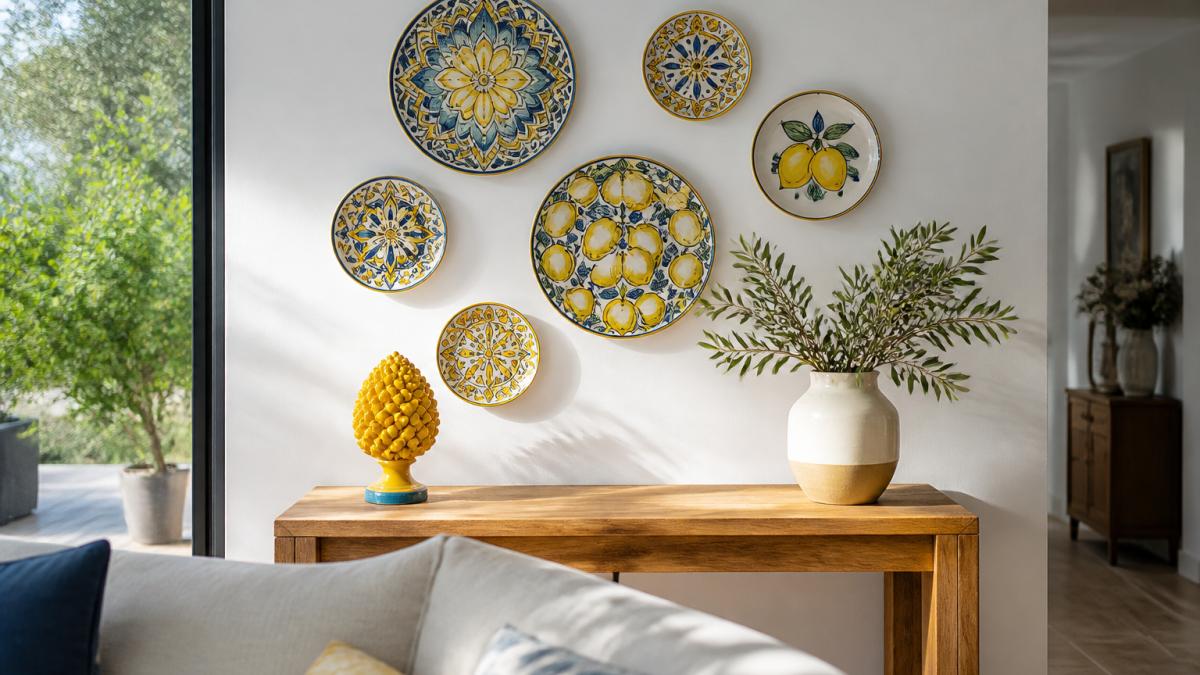
Sicilian ceramics work best in a modern interior when you treat them as the only loud element in the room. Group plates of different sizes on one wall, keep the surrounding palette neutral, and let the yellow and cobalt do the work.
Layouts That Work
- Symmetrical pair: two Moorish heads or two matching plates flanking a mirror, doorway or console. This is the most traditional arrangement and the easiest to get right. Keep the gap between the pair equal to roughly half the plate diameter.
- Gallery wall: a mix of three to seven plates of different diameters, hung 5-8 cm apart, centred on the wall rather than the furniture below. Start with the largest piece slightly off-centre and build outward.
- Vertical stack: three plates of descending size hung in a column, useful in a narrow hallway or beside a tall cabinet. Align the centres, not the edges.
Room-by-Room
- Kitchen: lemon wall fruit at eye level near a window, where the yellow reads warmest. Avoid directly above a hob or kettle, where steam and heat stress the glaze.
- Hallway: the cart wheel or a vertical stack, because a hallway wall is seen at an angle and benefits from a strong single colour.
- Dining room: a symmetrical pair above a sideboard, with a Caltagirone ceramic centrepiece with lemons on the console below to tie the grouping together.
Hanging Hardware and Safety
A 30 cm plate can weigh well over a kilogram, and gravity always wins eventually. Match the fixing to the weight rather than guessing.
- Weigh the piece on kitchen scales before choosing a fixing
- Use a spring plate hanger rated above the piece's weight, or a purpose-made wall bracket for heavier pieces
- Fix into a stud or use appropriate masonry anchors for the wall type
Light and Colour
Sicilian glazes are fired rather than painted on, and direct sun over long periods can fade strong colours. Hang plates on a wall that gets indirect light, and rotate pieces between rooms if you want to spread the exposure. Against a neutral wall, cobalt and lemon read as the loudest elements in the room; against a dark wall, the same plates read as jewel-like.
Choosing Your First Sicilian Ceramic Piece
Start with a single lemon wall fruit or a small plate, live with it for a season, then build. Collectors who buy one considered piece a year end up with a wall that looks curated rather than accumulated.
The honest limitation: these are handmade objects, and small imperfections in the glaze are the signature of artisanal work, not a fault. If you want machine-perfect uniformity, this is not the category for you.
Frequently Asked Questions
How can you tell if a Sicilian ceramic plate is authentic?
Turn the piece over. The unglazed foot should feel rough and gritty, not smooth and white, because smooth bases usually point to slip-cast imports rather than traditional clay. Look for a maker mark or fire mark, check that the brushwork varies slightly from piece to piece, and ask for a Made in Italy certificate. Authentic Sicilian ceramic wall plates are hand-thrown and hand-painted, so small imperfections in the glaze or pattern are normal and expected.
What designs are traditional on Sicilian ceramic wall plates?
The most recognisable motifs are lemons and citrus branches, Moorish heads (testa di moro), pine cones (pigna), Sicilian cart wheels and geometric red-and-green borders. Colours tend to be strong: cobalt blue, sunflower yellow, terracotta and emerald. Many Caltagirone ceramic plates combine a fruit centre with a decorative rim, which is why they work as standalone wall pieces rather than only as tableware.
How do you hang ceramic plates on a wall safely?
Use a proper plate hanger sized to the diameter, or a spring-loaded wire hanger for lighter pieces, and fix it into a wall stud or a masonry plug rated for the weight. Adhesive strips alone are risky on textured or painted walls. Hang larger pieces at eye level, keep them out of direct sun to protect the glaze, and check the fixing every few months.
How should you clean and care for hand-painted ceramic plates?
Dust with a soft dry cloth weekly and wipe with lukewarm water and a mild detergent when needed. Avoid abrasive pads. Do not soak wall pieces, and never hang a plate while it is still damp. If a piece is purely decorative, keep it away from steam above a stovetop, since repeated moisture can work into the unglazed base.
Are Sicilian ceramic plates handmade or mass-produced?
Genuine Caltagirone pieces are handmade, which is why no two are identical. Traditional Sicilian ceramic production has a long history, and the pieces featured here are handmade. Mass-produced lookalikes copy the motifs but skip the hand work, so the pattern is uniform and the base is smooth. Asking for a certificate and checking the base are the fastest ways to tell the difference.
Ready to bring a piece of Sicilian heritage into your home? At Constance & Belle, every ceramic is handmade and hand-decorated in Caltagirone, from our lemon wall fruit to our Moor heads, with Made in Italy certification on selected pieces and immediate delivery on items in stock. Get started with Constance & Belle and add a piece of the Mediterranean to your wall this week.
