

Last Updated: November 17, 2026
Quick Summary
Origine italiana describes a source or background, while la straniera describes a person or thing that is foreign. One is about where something comes from; the other is about who or what it is. Origine italiana is a noun plus adjective, while la straniera is a noun with a definite article.
- Origine is feminine, so the adjective must agree: origine italiana, not origine italiano.
- The plural origini italiane suggests heritage or lineage rather than a single point of manufacture.
- Estero names a place or category, while straniero names a person or a thing.
- La straniera always carries its article when it functions as a noun.
- In much of the south, including Sicily, straniero is often used for anyone from outside the local town.
Table of Contents
- Origine Italiana vs La Straniera: The Core Difference
- What Is the Origine Italiana Meaning?
- La Straniera Meaning: Foreign Woman, Foreign Thing, or Both?
- Origini Italiane Grammar: Why the Plural Changes the Sentence
- Italian Words for Foreigner: Straniero, Straniera, Estero and Stranieri
- Adjective vs Noun: How Each Phrase Behaves in a Sentence
- Regional and Dialectal Variations in Everyday Use
- Bringing Sicilian Heritage Home
- Frequently Asked Questions
Origine Italiana vs La Straniera: The Core Difference
According to Istat's demographic indicators for 2025, Italy's resident population includes millions of people born outside the country, which is exactly why the distinction between origini italiana vs la straniera matters so much in everyday Italian. The short answer: origine italiana describes a source or background, while la straniera describes a person or thing that is foreign. One is about where something comes from. The other is about who or what it is.
Below, we break down the grammar, the meanings and the everyday usage, so you can read a ceramic maker's label or an opera synopsis with confidence.
One Describes Origin, the Other Describes a Person
Origine italiana is a noun phrase built from origine (origin, source) plus the adjective italiana. It answers the question "where does this come from?" A vase, a surname, a recipe or a family line can all have an origine italiana.
La straniera is a noun. It means "the foreign woman" or, in specific contexts, "the foreign thing." It answers "who is this?" or "what is this?" It never describes a source.
The confusion usually comes from translation. English uses "foreign" and "origin" loosely; Italian keeps them in separate grammatical boxes.
A Quick Reference Table
| Question | Origine Italiana | La Straniera |
|---|---|---|
| What does it describe? | A source or background | A person or thing that is foreign |
| Grammatical role | Noun + adjective | Noun with definite article |
| Gender | Feminine singular | Feminine singular |
| Plural form | Origini italiane | Le straniere |
| Typical use | "di origine italiana" | "la straniera" as subject |
| English equivalent | Italian origin | The foreign woman |
What Is the Origine Italiana Meaning?
The origine italiana meaning is straightforward: it names Italian origin or Italian descent. The phrase tells you where something or someone comes from, not what they are.
You will see it in three common patterns:
- Di origine italiana, "of Italian origin," used for people, families and products.
- Origine italiana garantita, "guaranteed Italian origin," a claim on packaging and labels.
- Paese di origine italiana, "country of Italian origin," used in trade and customs paperwork.
Note that origine is a feminine noun, so the adjective must agree: origine italiana, not origine italiano. That single vowel is where many learners slip.
La Straniera Meaning: Foreign Woman, Foreign Thing, or Both?
The la straniera meaning depends on context, and this is where the phrase earns its reputation for trickiness. Most often, la straniera means "the foreign woman": a woman who is not a citizen or native of the place being discussed.
But Italian also uses the feminine form for objects. La straniera can mean "the foreign one" when the noun it replaces is feminine, such as la parola straniera (the foreign word) or la merce straniera (foreign goods). In opera, La straniera is the title of a Bellini work, where it names the female protagonist.
Three quick usage examples:
- La straniera che vive qui da anni parla italiano benissimo., The foreign woman who has lived here for years speaks Italian very well.
- Questa parola è una straniera nella nostra lingua., This word is a foreigner in our language.
- La straniera (Bellini), the opera title.
Origini Italiane Grammar: Why the Plural Changes the Sentence
Origini italiane grammar follows a simple rule with a big effect: origine becomes origini in the plural, and the adjective follows to italiane. The plural shifts the phrase from a single source to a set of roots or ancestries.
Compare the two:
- Di origine italiana, of Italian origin (one origin, one person or item).
- Di origini italiane, of Italian origins (a family line, a mixed background, or several sources).
In practice, origini italiane is the warmer, more human form. It suggests heritage rather than a single point of manufacture. A maker's family might have origini italiane; a single piece of ceramic has an origine italiana.
The plural also changes the article: le origini italiane. You will see this in museum labels, family histories and heritage brand copy.
Italian Words for Foreigner: Straniero, Straniera, Estero and Stranieri
The Italian words for foreigner form a small family, and each member has its own job. Mixing them up is one of the most common errors we see.
- Straniero, masculine singular noun or adjective: a foreign man, or a foreign thing that is masculine.
- Straniera, feminine singular: a foreign woman, or a foreign thing that is feminine.
- Stranieri, masculine plural, or mixed-gender plural.
- Estero, a noun meaning "abroad" or "foreign country," as in all'estero (abroad). It is not a person.
- Estera, the feminine adjective form of estero, used for things like merce estera (foreign goods).
The trap is estero versus straniero. Estero names a place or a category; straniero names a person or a thing. A person is never estero.
A second trap: stranieri is the default plural for a mixed group, even if there are many women in it. Italian uses the masculine plural for mixed groups, which surprises many learners.
Adjective vs Noun: How Each Phrase Behaves in a Sentence
This is the distinction most guides skip, and it changes how you build a sentence. Origine italiana is a noun plus an adjective. La straniera is a noun with a definite article. They occupy different slots in a sentence, and the quickest way to see the difference is to run each phrase through four tests.
Test 1: Can it be the subject?
Origine italiana cannot stand alone as a subject. It needs a host noun and the preposition di: un mobile di origine italiana (a piece of furniture of Italian origin), un vino di origine italiana (a wine of Italian origin). Remove the host noun and the phrase has nothing to attach to.
La straniera stands alone: La straniera è arrivata ieri (The foreign woman arrived yesterday), La straniera ha chiesto indicazioni (The foreign woman asked for directions). It takes verbs directly and can be replaced by a pronoun: Lei è arrivata ieri.
Test 2: Does it need an article?
Origine italiana rarely takes a definite article in its common patterns. You say di origine italiana, not della origine italiana. The article appears only when the phrase is the subject of a full clause, as in L'origine italiana del prodotto è certificata (The Italian origin of the product is certified).
La straniera always carries its article when it functions as a noun. Drop the article and the meaning shifts: una straniera is "a foreign woman" (one of many), while la straniera is "the foreign woman" (a specific one already in view). That article swap is where learners most often slip.
Test 3: How does it agree?
Origine is feminine, so the adjective must agree with origine, not with the person or object being described: origine italiana, origini italiane. A male maker still produces a piece di origine italiana.
Straniera agrees with the noun it modifies or replaces. As a noun it agrees with the person: lo straniero, la straniera, gli stranieri, le straniere. As an adjective it agrees with whatever it describes: una tradizione straniera (a foreign tradition), un usanza straniera (a foreign custom), prodotti stranieri (foreign products).
Test 4: Can it be replaced by a pronoun?
La straniera can: La straniera è arrivata e lei ha portato i documenti (The foreign woman arrived and she brought the documents). Origine italiana cannot be pronominalised on its own; the whole noun phrase is what gets replaced: Il mobile è di origine italiana e lo è anche il tavolo (The furniture is of Italian origin and so is the table).
Worked contrast
| Test | Origine Italiana | La Straniera |
|---|---|---|
| Can it be a subject? | No | Yes |
| Needs "di" before it? | Usually | No |
| Takes a definite article? | Rarely | Always as a noun |
| Agrees in gender/number? | Yes, with origine | Yes, with the person or thing |
| Pronoun replacement? | No | Yes |
One more point: straniera can also work as an adjective, as in una tradizione straniera. In that role it behaves like any other adjective and follows the noun. The same word can therefore be a noun (la straniera) or an adjective (la tradizione straniera), and only the article and position tell you which.
Watch out: do not assume la straniera is always a person. When the noun it replaces is feminine and inanimate, it means "the foreign one", la merce straniera (foreign goods), la parola straniera (the foreign word). The grammar is identical; only context disambiguates.
Regional and Dialectal Variations in Everyday Use
Regional usage adds colour to both phrases, and it is where a textbook and a Sicilian market stall part ways. The differences are real, but they follow patterns you can learn.
The local sense of straniero
In much of the south, including Sicily, straniero is often used for anyone from outside the local town, not just outside the country. A person from the next province can be straniero in casual speech. The same pattern appears in market towns where belonging is tied to the parish or the quarter rather than to a passport. In context the local sense rarely causes confusion, because the speaker usually names the place: è straniero, viene da Catania (he is a foreigner, he comes from Catania).
In the north, by contrast, straniero more often maps onto national or linguistic difference, and extracomunitario appears in administrative and journalistic language for people from outside the EU. That word is bureaucratic rather than neutral, and many speakers avoid it in conversation.
Dialect forms you will actually hear
Sicilian and Neapolitan have their own words for "foreigner," and older speakers may use them where standard Italian would use straniero. In Sicilian, straniu and furasteri both circulate, the second closer to the sense of "outsider" or "one from elsewhere." In Neapolitan, straniero and furastiero appear alongside standard forms. You will hear these in family stories and local markets rather than in formal writing, and they carry a warmer or more ironic tone than the standard word.
For origine italiana, regional variation shows up in food and craft labelling rather than in dialect. A Sicilian ceramic maker may stress origine italiana to distinguish the piece from imported copies, while a mainland producer might use origini italiane to speak about family heritage. Both are correct; the choice signals what the seller wants you to notice. On a label, origine italiana is a claim about where the item was made or sourced, while origini italiane is a claim about lineage, and the plural is the tell.
What this means when you read a label
A single piece of ceramic carries an origine italiana; a family firm carries origini italiane. When a seller writes origini italiane, ask what the plural is doing: it may mean the family has Italian roots while the workshop is elsewhere, or that several production steps happen in the country. When a seller writes origine italiana, the claim is narrower and easier to verify against the place of manufacture.
Watch out: regional usage can make straniero sound harsher than intended. In a local context it may simply mean "not from here," but to a listener from outside the region it can land as exclusion. If you are unsure, name the place instead of using the label.
Bringing Sicilian Heritage Home
Understanding origine italiana versus la straniera changes how you read a label, and it changes how you choose a piece for your home. When a maker states an Italian origin, that claim should be specific, traceable and matched by the craft itself.
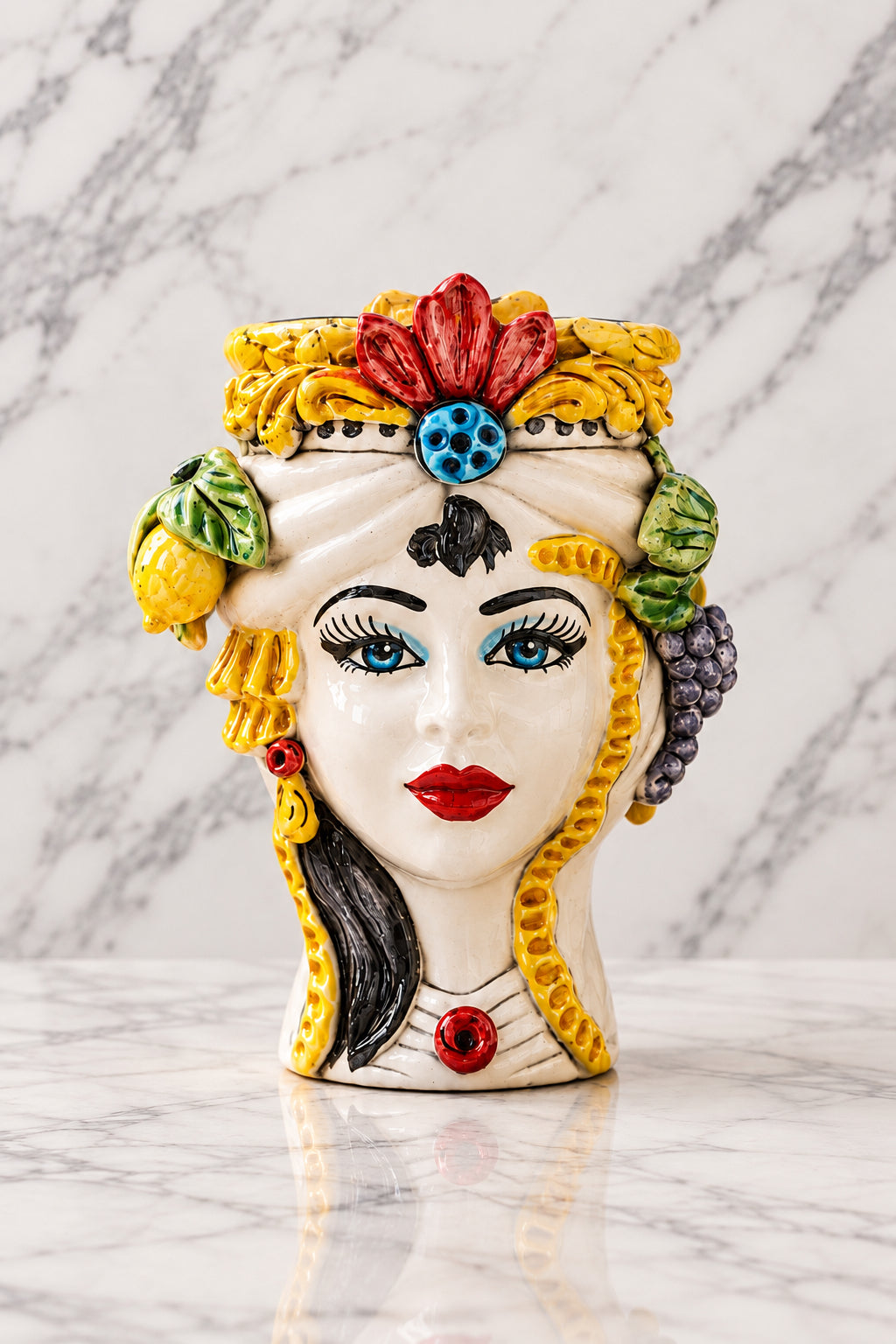
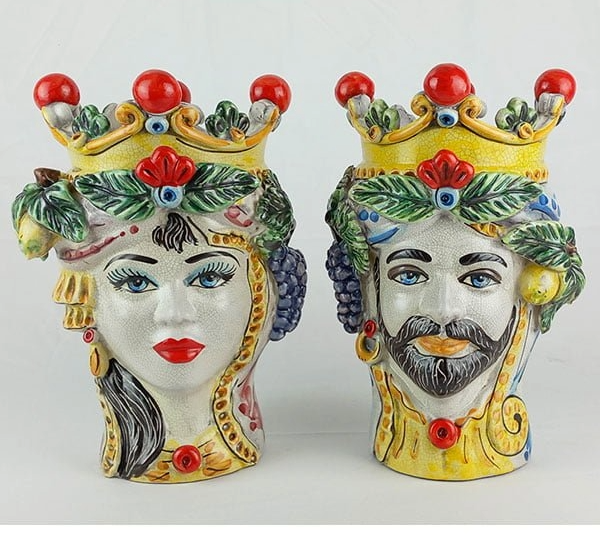
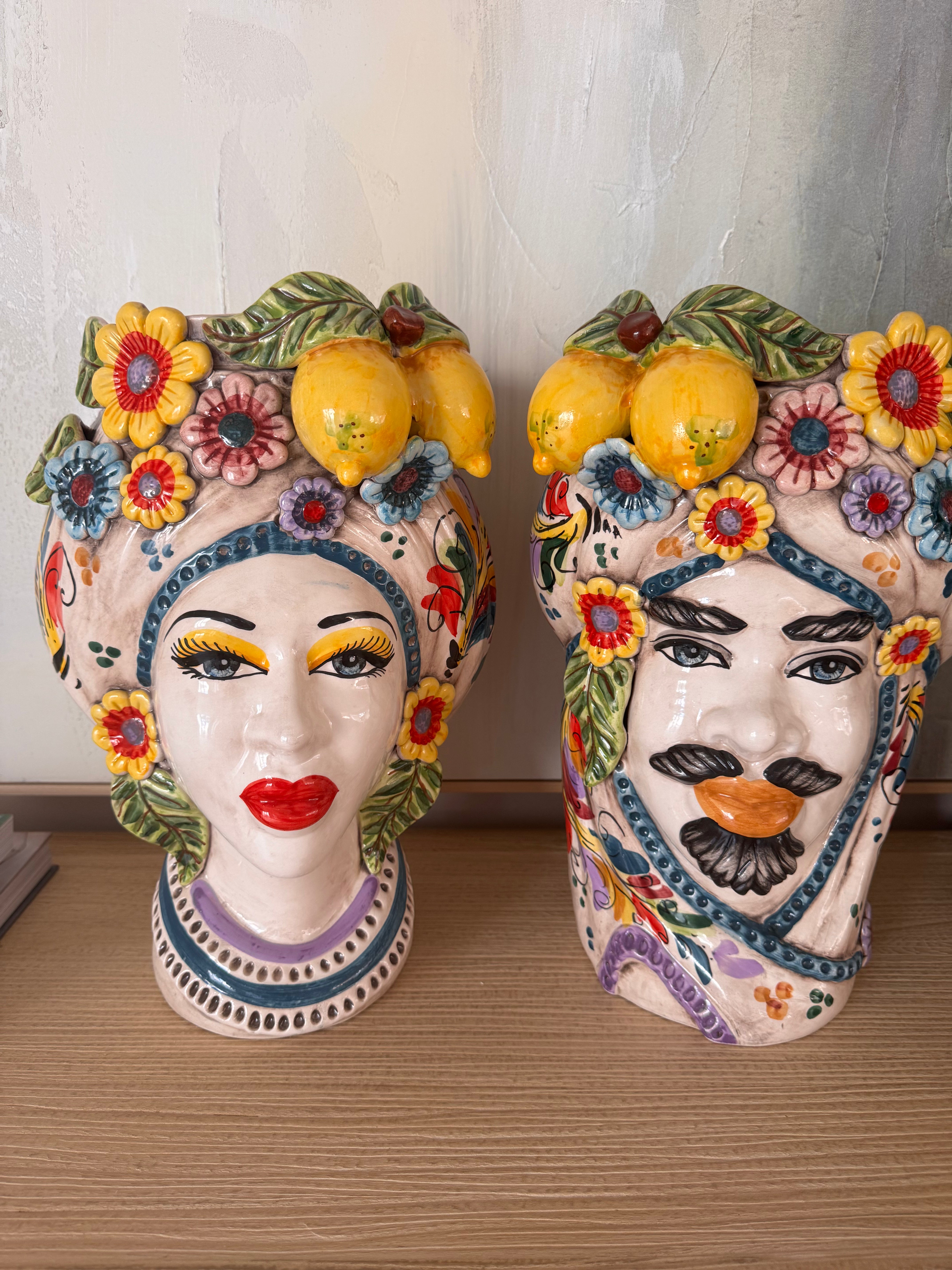
If you are drawn to the Testa di Moro Caltagirone ceramic piece, you can explore its handcrafted Sicilian ceramic design. For a classic pair, the crowned Moor head couple features enamel decoration. And if you want a statement piece, the Testa di Moro Spring at 40cm brings the same heritage into a larger form.
The difference between a label and a story is often a single, well-chosen piece. Constance & Belle curates artisanal home goods inspired by Sicilian heritage, with handmade ceramics and sustainable pieces that bring warmth to everyday rituals. Browse our collection to find the piece that speaks to your own sense of origin and craft.
Frequently Asked Questions
What does la straniera mean in English?
La straniera translates to 'the foreign woman' or 'the foreign one' (feminine). It combines the definite article la with the feminine noun straniera, which comes from straniero (foreigner). In everyday Italian, it can describe a woman from another country, or a feminine object that is foreign in origin. The meaning depends on context, but it always carries the sense of something or someone outside the native group.
Is origine italiana the same as origini italiane?
No. Origine italiana is singular and refers to one Italian origin, often used for a single person, product, or heritage claim. Origini italiane is plural and refers to multiple Italian origins, such as a family's ancestral roots or a product's multiple source regions. The grammar changes with the noun: origine is singular feminine, origini is plural feminine. Use the plural when you mean roots or background in a broader sense.
How do you use straniera in an Italian sentence?
Straniera functions as both a noun and an adjective. As a noun: 'La straniera è arrivata ieri' (The foreign woman arrived yesterday). As an adjective: 'La cucina straniera mi piace' (I like foreign cuisine). It agrees in gender and number with the noun it modifies: straniero (masculine singular), straniera (feminine singular), stranieri (masculine plural), straniere (feminine plural). Use it to describe people, products, or ideas from outside Italy.
Does la straniera refer to a foreign woman or a foreign thing?
La straniera can refer to either, depending on the noun it replaces or modifies. Grammatically feminine, it most commonly describes a foreign woman. But in contexts like 'la moda straniera' (foreign fashion), the feminine noun moda makes straniera an adjective describing a thing. Without a clear noun, readers assume a person. So context decides: a foreign woman is the default, but a feminine object is possible.
What are the most common mistakes with Italian words for foreigner?
Two common errors: using straniero for a woman (should be straniera), and confusing straniero with estero. Straniero means foreigner (a person), while estero means abroad or foreign country (a place). Another mistake is treating origine italiana and origini italiane as interchangeable; the plural implies multiple roots or sources, while the singular points to one. Finally, learners often forget adjective agreement, saying 'la straniero' instead of 'la straniera'.
